
Avoiding Financial Woes While Travelling
Welcome to my first text blog, everyone! Conveniently, the trip to Toronto (to be trained for this job) has led to this blog entry.


A look at what I wrote during a European bus tour.



Welcome to my first text blog, everyone! Conveniently, the trip to Toronto (to be trained for this job) has led to this blog entry.

Welcome to my first text blog, everyone! Conveniently, the trip to Toronto (to be trained for this job) has led to this blog entry. Prior to attending the RBCp2p Blogger Bootcamp I had flown only once in my life.
The flight to Toronto was fine and much more effortless than I had anticipated. My experience during the return to Halifax inspired the following, as I found myself in a series of uncomfortable and frustrating situations. There were flight delays (6:40pm - 8pm; not so bad), cancellations (8pm fight canceled altogether; getting worse), and re-routes (flew above Halifax but could not land due to fog, then to Montreal to re-fuel and BACK to Toronto; pretty bad).
During this turmoil, I realized that a few things helped to reduce my misery (italicized below). To those among you who are not frequent travelers, there is nonetheless a cautionary message here: be prepared! What follows is a list of things to consider when traveling.
Most hotels will require you to have a credit card to book a room, and they may also place a deposit on your card, in case something happens to the room. If a deposit is required and it puts your balance over your card's limit, there is no penalty, but you will not have access to that money. I discovered this while paying for the second hotel of the weekend (due to the first flight being canceled). If you tend to carry a high balance, this is where a second credit card isn't necessarily a bad idea. Also, try to avoid the mini-bar, even though it is often tempting. Ironically, I made a conscious point of staying away from all food and beverage items in it, only to have the hotel charge me (incorrectly) for them. So the final point about hotels is to make sure you check your credit card afterwards in case anything was accidentally billed.
The same applies to car rental companies. You will need a credit card to rent a car, so if your flight doesn't leave until 8:55pm the day after it was originally scheduled to fly (for example) and you're considering flying to a city NEAR yours and driving the rest of the way (hypothetically), make sure you have a credit card (and a license that's not expired, while your current one sits in the pocket of a coat that hangs in the home you're trying so desperately to get back to).
Before traveling somewhere it is wise to check with your cell phone provider to see if there is a long distance add-on that will reduce the cost of any phone calls made throughout the trip. Depending on your provider it may be considered long distance for you to receive ANY phone calls while you're outside your local calling area (the area where your phone number originates). It may seem obvious, but text messaging is an affordable way to avoid paying long distance fees, and if you don't have a package before the trip you will want to consider adding one on to cover the potential increase in texting. I'll address this in a future blog, but data devices can really be beneficial while traveling. Once considered more appropriate for businesspeople, they have really dropped in price, and the data plans are also much more affordable. The monthly cost of a data plan might very well be less than that of logging into a Wi-Fi network just once. It's something to consider if you're a frequent traveler.
Let us suppose that you end up spending a SECOND unexpected night in the city you're trying to escape, and you NEED to get online. Airports and hotels often offer Wi-Fi access, but guess what, you need a credit card to do this as well. Something else to consider is when and where you choose to log in, as you could end up paying for it in the hotel only to be checked out at noon (let's say) and spending many hours in the airport where you would have to pay AGAIN to get online. Nobody wants to pay $13-$14 for 24 hours of access when they will only have a couple of hours worth of possible access.
In no way has the previous blog been intended to push a credit card upon you. My hope is that some of what you've just read has helped you, or perhaps reminded you of past experiences, with an end result of saving you time and money. Feel free to add any of your own tips, or ask questions. Stay tuned for my upcoming blog entry, Part 1 of my discussion on telecommunications services and how to hopefully save yourself some money in the process.
A frugalitarian’s quest to find nice used clothes.

I don’t like to spend money. I would consider myself frugal in a lot of ways. I especially don’t like to pay a fortune for clothes. I understand that what I am about to say is not for everyone, and you would have to examine within yourself why you feel that way. The fact is, though, that buying used clothing just makes more sense.
Allow me to outline several ways in which I think it does:
It is considerably less expensive to buy used clothing. There is no denying that. Some may argue that they can not find what they really want in a used clothing store. That is a fair argument, but the question is why do you want those certain articles of clothing? Is it partially because you’re being convinced you need that brand or that style? As the photo below demonstrates, the other day I purchased 15 articles of clothing (and nice – in my opinion and that of others – clothing, too) for $87.41 after tax. That’s insane! In some ways, you can MAKE money from selling your own clothes, and consignment shops can be an easy way to achieve this.
Many of us recycle, or pretend to. A great deal of us even try to reduce our consumption. The third ‘R’ is the one that I think gets left behind by a lot of people. Buying used clothing is applying the "reuse" portion of the 3 R’s. The fact that no more manufacturing and resources has to go into making new clothing for me to wear is a good feeling. There is already enough clothing made right now to suit us for a very long time, I imagine, but fads, style and trends make them “obsolete” quickly. I personally don’t mind being a couple of “seasons” behind (or even years) if it means that I can help reduce the strain that clothing manufacturing takes on the planet.
I find that shopping in used clothing stores leads to finding clothes that you won’t see others wearing. In many cases, this is because it is older and has since stopped being sold. Or, a lot of the time it comes from other countries and may never have been available here. If the brands are not immediately recognizable to those working (or owning) the stores then you may get super high quality clothes at a remarkably low price. I know, you’re thinking of someone who shops at these stores who dresses, in your opinion, horribly. Well, that is your opinion; it doesn’t mean that you wouldn’t find drastically different clothing there for yourself.
The receipt in the photo lists 15 items. Let me see what I got: 2 t-shirts, 3 short-sleeved button-up shirts, one long-sleeved button-up shirt, 6 long-sleeved outerwear, one pair of jeans and a belt. Wait, that’s 14. Hmmm…I think I may have been charged twice for something. That’s it! Never again! Oh wait, that item cost me at most $6.99 and the total was still only $87.41. I may just be missing an item, somewhere in my closet.
Have YOU found something particularly nice at a used clothing store that you’re dying to tell everyone about? Go ahead and dish! Until next time…that’s life as I know it.
One blogger’s relationship with razor blades.

As I sit here writing this entry I am in need of a shave.
Not desperately in need of one, but it would be a good idea. But, oh what’s this? I’m out of razor blades, and I will readily admit that razor blades are among the things I most despise buying. The reasons are simple enough:
By my calculations, blades usually run me $14 after tax for a 4-pack. Divide that by the four blades and each blade is about $3.50. Considering I get 3-3.5 REALLY good shaves out of a blade (those among you who shave larger areas would get less), I wish I could somehow find a way to shave with loonies. It would make the whole process more efficient, don’t you agree?
LOONbricating strips. Anyone? No?
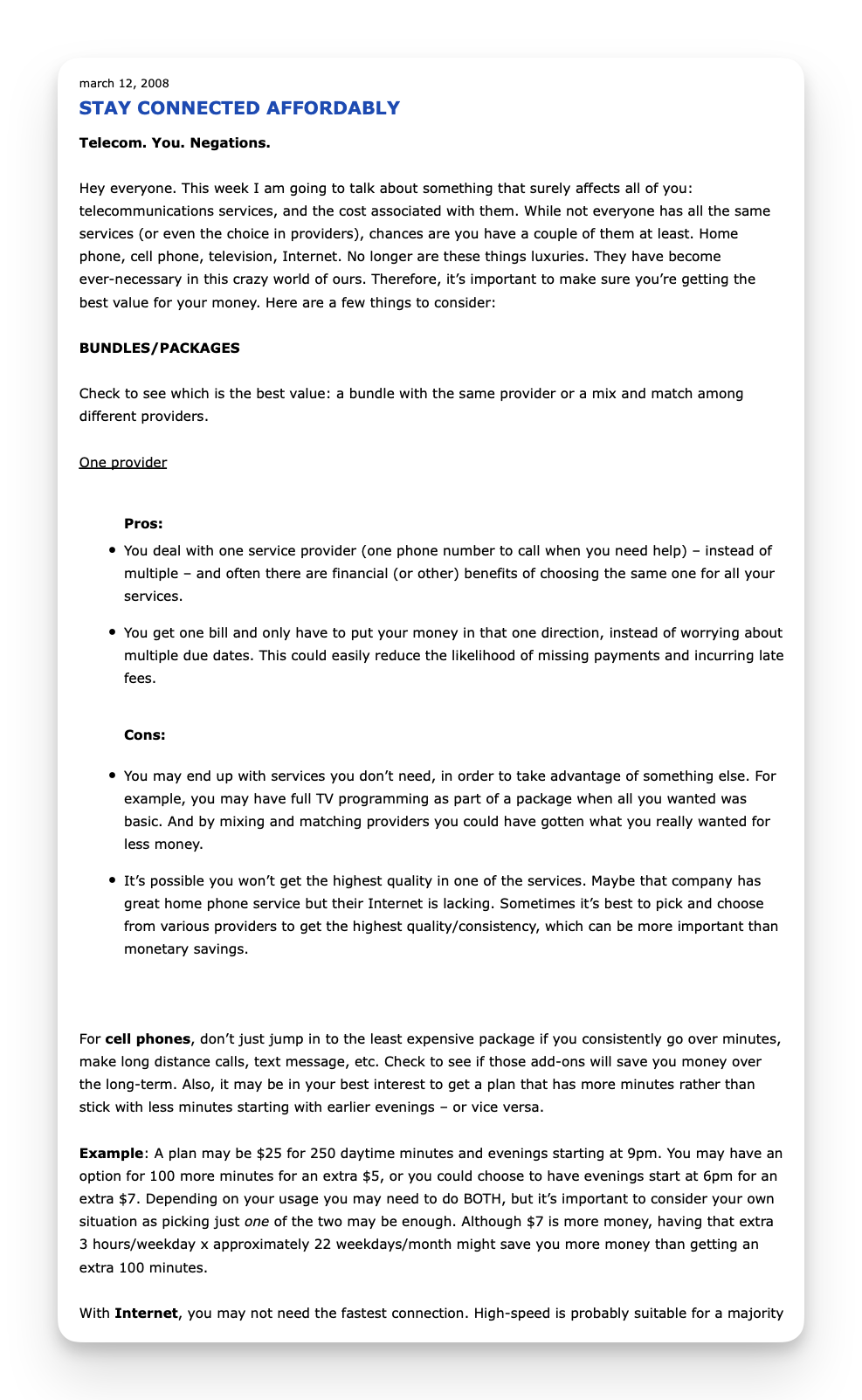
Telecom. You. Negations.

Hey everyone. This week I am going to talk about something that surely affects all of you: telecommunications services, and the cost associated with them. While not everyone has all the same services (or even the choice in providers), chances are you have a couple of them at least. Home phone, cell phone, television, Internet. No longer are these things luxuries. They have become ever-necessary in this crazy world of ours. Therefore, it’s important to make sure you’re getting the best value for your money. Here are a few things to consider:
Check to see which is the best value: a bundle with the same provider or a mix and match among different providers.
Pros:
Cons:
For cell phones, don’t just jump in to the least expensive package if you consistently go over minutes, make long distance calls, text message, etc. Check to see if those add-ons will save you money over the long-term. Also, it may be in your best interest to get a plan that has more minutes rather than stick with less minutes starting with earlier evenings – or vice versa.
Example: A plan may be $25 for 250 daytime minutes and evenings starting at 9pm. You may have an option for 100 more minutes for an extra $5, or you could choose to have evenings start at 6pm for an extra $7. Depending on your usage you may need to do BOTH, but it’s important to consider your own situation as picking just one of the two may be enough. Although $7 is more money, having that extra 3 hours/weekday x approximately 22 weekdays/month might save you more money than getting an extra 100 minutes.
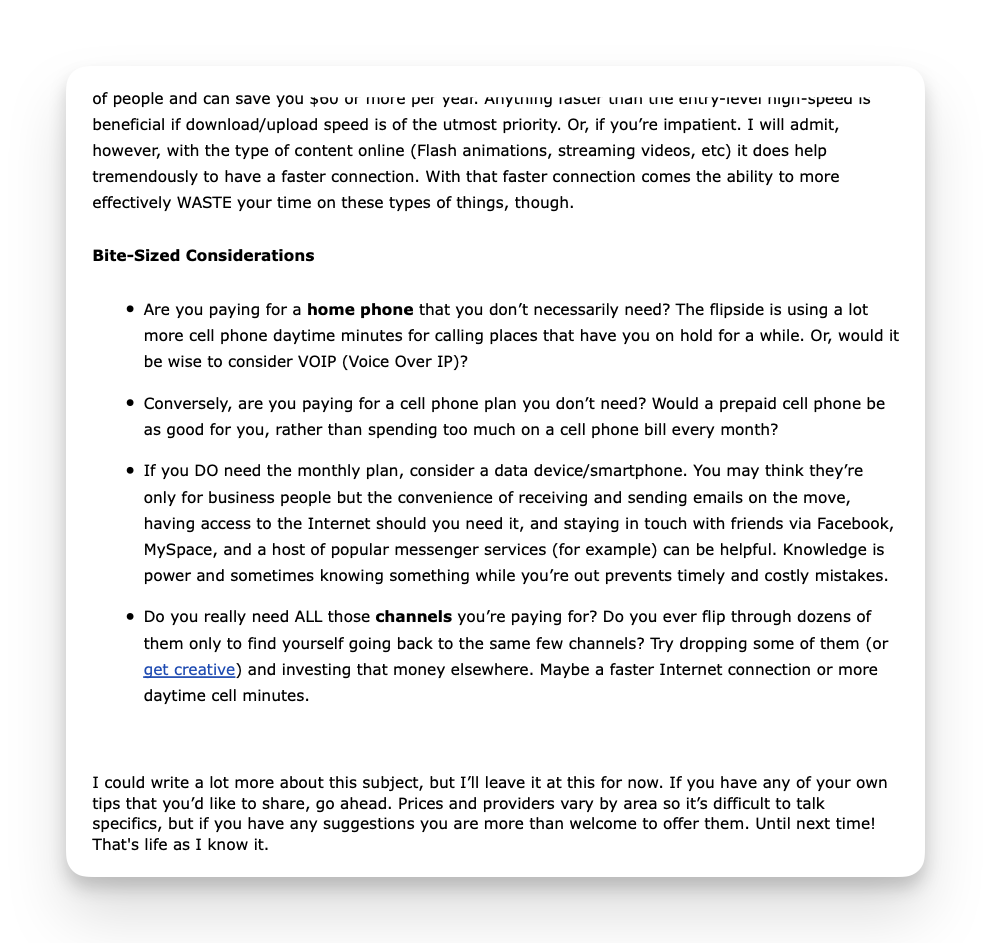
With Internet, you may not need the fastest connection. High-speed is probably suitable for a majority of people and can save you $60 or more per year. Anything faster than the entry-level high-speed is beneficial if download/upload speed is of the utmost priority. Or, if you’re impatient. I will admit, however, with the type of content online (Flash animations, streaming videos, etc) it does help tremendously to have a faster connection. With that faster connection comes the ability to more effectively WASTE your time on these types of things, though.
I could write a lot more about this subject, but I’ll leave it at this for now. If you have any of your own tips that you’d like to share, go ahead. Prices and providers vary by area so it’s difficult to talk specifics, but if you have any suggestions you are more than welcome to offer them. Until next time!
That's life as I know it.
You may be able to see the original on The Wayback Machine.