What We Lost When Everything Got Easy

I remember a time not so long ago when doing something slightly inconvenient was just part of how things worked.
If you wanted a song, you fired up Limewire, Napster, or Kazaa and waited. Sometimes for minutes, sometimes longer, watching that progress bar crawl forward. You hoped the file was actually what it claimed to be. If it wasn’t, you tried again. If it was close enough, you might keep it rather than start over. The process was imperfect, but it required patience and attention.
Learning worked much the same way. You didn’t get an instant, authoritative answer in seconds. You followed a trail. A search led you to a forum post from four years ago, which cited a book you couldn’t find, which referenced a concept you had to look up separately. Some sources contradicted each other. Some assumed knowledge you didn’t have yet. You kept a tab open for days because you hadn’t fully figured out what it was telling you. You pieced things together gradually, and the understanding you built felt different because of how long you’d carried it around.
Making things followed a similar pattern. You opened Photoshop with a vague idea and no clear path to it. There were no polished templates waiting, no marketplace of ready-made starting points. If you wanted to know how to do something, you might find a blog post someone had written three years earlier with screenshots that no longer matched the version you were running. Or a list of the ten best Photoshop tutorials, linking out to sites of wildly varying quality — some thorough, some abandoned halfway through. You followed the ones that were close enough and improvised the rest. The outcome often looked different from what you’d imagined at the start — not because you’d failed, but because the process had shaped it.
All of this involved some level of friction. It showed up in the waiting, the uncertainty, and the need to overcome little obstacles along the way. At the time, it often felt like something to eliminate, to reduce the number of steps between wanting something and having it.
That instinct has largely won.
Today, the distance between intention and output has collapsed. You can generate writing, images, plans, and ideas almost instantly. Tools are designed to remove effort, to streamline the path, and to produce results with minimal resistance. What used to take hours or days can now take minutes or seconds.
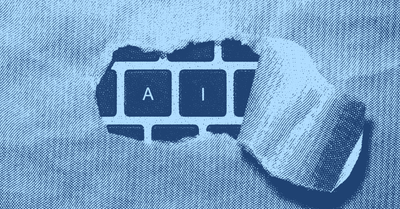
The most obvious version of this is AI. The problem is how most people use it: a single prompt, a completed draft, done. All the in-between stages disappear. The refinement, the iteration. That’s often where the magic happens, and it’s exactly what gets skipped.
When the process becomes too smooth, you start to disappear from it. You still arrive at an outcome, but you spent very little time inside the process that produced it. The output might be technically sound, but you didn’t do enough to make it yours.
I remember working in Photoshop, unsure of the proper way to do something, and finding a workaround instead. The result was sometimes something a professional wouldn’t have arrived at — not despite the limitation, but because of it.
I’ve done a lot of writing, straight from my mind onto the page. It didn’t exist, then I strung the words together to bring them into being.
They may not be perfect, but they belong to me.
When I’ve used AI to generate something with minimal involvement, it’s easier to forget. Conjuring the words myself, almost as if by magic, solidifies them within me.
Not just outside of me.
Friction, in the right places, creates involvement. It requires attention, invites judgment, and forces you to stay with the work long enough for it to take on some weight. When the internal conversation with your own intelligence is replaced with an artificial one, you slowly lose not only the ability to converse, but the desire to.
Friction was never just a flaw in the system. It was part of what made the process feel real, and part of what made the outcome feel like it belonged to you.